
Payroll management small business india
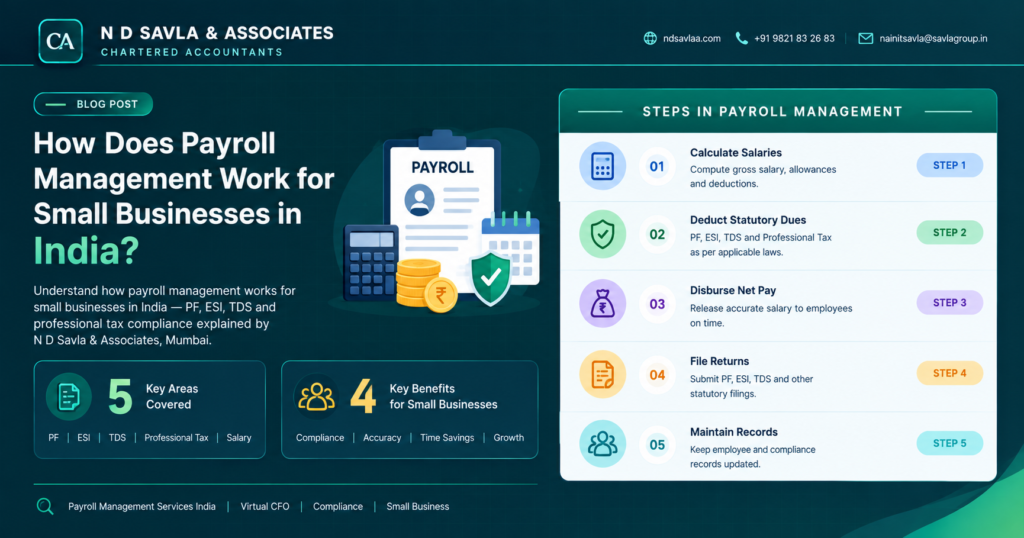
Virtual CFO · Payroll Compliance How Does Payroll Management Work for Small Businesses in India? A practical walk-through of PF, ESI, professional tax and TDS compliance — and the monthly cycle that keeps a growing team’s salaries accurate and penalty-free. By N D Savla & Associates 18 September 2026 Andheri East, Mumbai 7 min read Payroll management is the process of calculating employee salaries, deducting statutory dues such as Provident Fund, Employee State Insurance, Professional Tax, and Tax Deducted at Source, and disbursing accurate net pay on a fixed monthly schedule. For a small business in India, payroll management services India are not simply an administrative task — they determine whether a company stays compliant with the Income Tax Act 1961, the Employees’ Provident Fund and Miscellaneous Provisions Act 1952, and various state-level Shops and Establishments Acts. Small business owners often start payroll on a spreadsheet, but once headcount crosses five or six employees, the compliance burden multiplies quickly. A single missed Provident Fund deposit or an incorrect TDS calculation can trigger penalties, interest, and in serious cases prosecution under the relevant Act. This is exactly why a growing number of small businesses now rely on structured payroll management services India, either through an in-house payroll officer or a specialist firm such as N D Savla & Associates, to keep salary processing, statutory filings, and employee records accurate every single month. 15thPF & ESI deposit due date 7thTDS deposit due date 10+Employees triggers ESI 20+Employees, PF mandatory Why it matters What Is Payroll Management and Why Does It Matter for Small Businesses in India? Payroll management is the complete process of computing wages, applying statutory deductions, generating payslips, and remitting employer and employee contributions to the correct government authorities within prescribed due dates. For a small business, this matters because payroll touches several compliance regimes simultaneously — income tax, provident fund, employee state insurance, and professional tax — and each carries its own filing calendar and penalty structure. A small business with even ten employees must track TDS on salary under Section 192 of the Income Tax Act 1961, Provident Fund contributions under the EPF Act 1952, ESI contributions wherever wages fall within the ESI wage ceiling, and professional tax as prescribed by the relevant state legislation. Payroll management services India typically bundle salary structuring, statutory registrations, monthly processing, and annual filings such as Form 16 and Form 24Q into a single, predictable workflow. Real cost of getting it wrong The Employees’ Provident Fund Organisation can levy damages of up to 100% of the delayed contribution amount under Section 14B of the EPF Act, and an incorrect TDS deduction can expose the employer to disallowance of the salary expense under Section 40(a)(ia) of the Income Tax Act. Businesses that engage support through services such as Accounting & Tax Compliance from the outset generally avoid these accumulating costs because payroll is treated as a compliance function, not a back-office afterthought. The monthly cycle How Does Payroll Management Work for a Small Business in India? Payroll management for a small business in India follows a repeatable monthly cycle that begins with attendance capture and ends with statutory return filing. The exact sequence rarely changes, whether payroll is handled in-house or by an outsourced payroll management services India provider. 1 Employee Data & Salary Structure Setup Every employee’s PAN, bank account, UAN, and salary breakup — basic pay, HRA, special allowance, and statutory components — must be captured correctly before the first payroll run. Errors at this stage cascade into every subsequent month, so the salary structure should be finalised in the appointment letter itself. 2 Attendance & Leave Reconciliation Actual working days, approved leave, and loss-of-pay days are reconciled against the salary structure each month. This step directly affects gross pay and cannot be skipped even for a two- or three-person team, because it forms the basis for every deduction calculated afterward. 3 Gross Salary & Statutory Deduction Calculation Gross salary is computed, and Provident Fund, ESI, Professional Tax, and TDS on salary are deducted according to the applicable thresholds for that employee and state. This is the step where most manual errors occur, particularly around PF wage ceilings and ESI eligibility limits. 4 Payslip Generation & Net Pay Disbursement Payslips are generated showing gross pay, each deduction line item, and net pay, followed by disbursement into employee bank accounts, typically on or before the last working day of the month. 5 Statutory Payment & Return Filing Employer and employee PF contributions must be deposited with EPFO by the 15th of the following month, ESI contributions by the 15th, TDS on salary by the 7th, and professional tax by the state-specific due date. Missing any of these dates triggers interest and penalty under the respective Act. 6 Record-Keeping & Annual Compliance Annual obligations, including Form 16 issuance to employees, quarterly Form 24Q filing, and reconciliation of PF and ESI ledgers, close out the payroll cycle for the financial year and feed directly into the company’s income tax audit and financial statements. Documents to Have Ready Before the First Payroll Run Onboarding an employee correctly at the start avoids most downstream payroll errors. A well-run process collects the following before the first salary is processed: ✓PAN and Aadhaar of the employee ✓Bank account details for salary disbursement ✓Universal Account Number (UAN), if previously employed ✓Signed appointment letter with CTC breakup ✓Form 12B for mid-year joiners (previous employer income) ✓Investment declaration / tax regime choice for TDS estimation ✓ESI eligibility check based on gross wages ✓Professional Tax registration confirmed for the employee’s state Four recurring obligations What Are the Statutory Compliance Requirements in Indian Payroll Management? The statutory compliance requirements in Indian payroll management centre on four recurring obligations: Provident Fund, Employee State Insurance, Professional Tax, and Tax Deducted at Source on salary. Each has a distinct registration threshold, contribution rate, and filing frequency that a small business must track independently. EPF ACT 1952 Provident Fund Registration becomes mandatory once a business crosses
IFRS vs US GAAP: Key Differences Every Business and Finance Professional Must Know
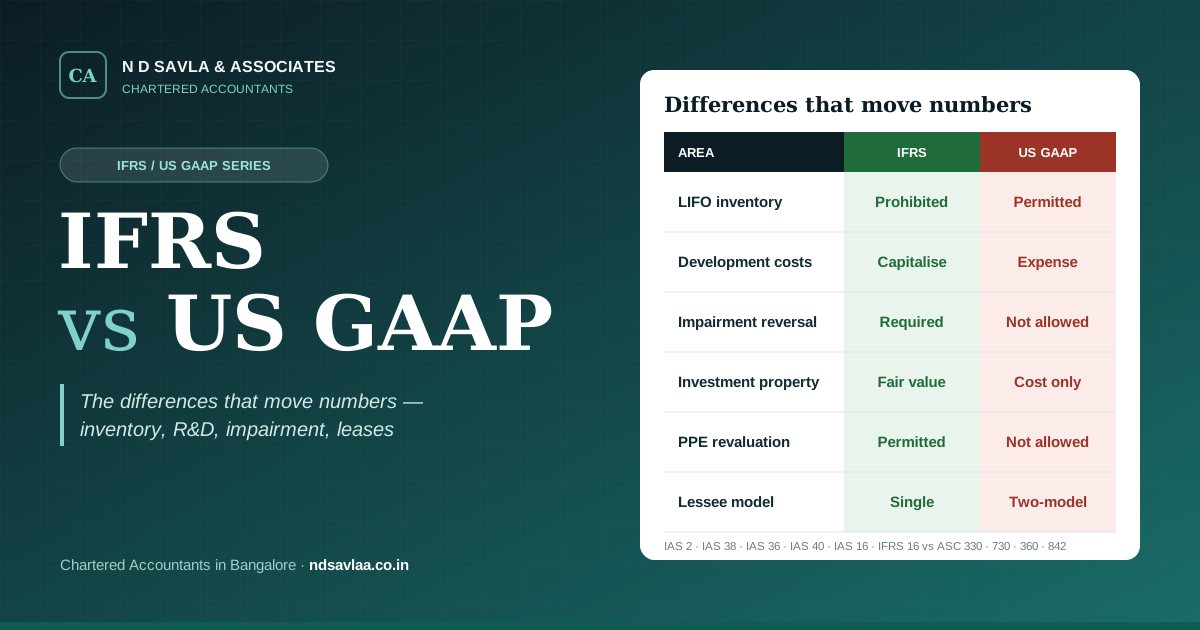
IFRS vs US GAAP: Key Differences Every Business and Finance Professional Must Know CA N D SAVLA & ASSOCIATES CHARTERED ACCOUNTANTS For Consultation +91 9743 000 773 IFRS / US GAAP / Financial Reporting IFRS vs US GAAP: Key Differences Every Business and Finance Professional Must Know The differences that move numbers — inventory, leases, development costs, impairment and investment property — and what each one does to ratios, analyst adjustments and cross-border deals. By N D Savla & Associates · 8 September 2026 · Chartered Accountants in Bangalore A pharmaceutical company in Germany developing a new drug and a pharmaceutical company in New Jersey developing the same drug — same science, same investment, same commercial prospects — can report dramatically different financial statements if one follows IFRS and the other follows US GAAP. The German company, under IAS 38, is required to capitalise development costs once feasibility is established; the New Jersey company, under ASC 730, expenses them as incurred. Same economic reality, different accounting — and the difference affects not just net income but assets, equity, and every ratio built on those numbers. This is what IFRS vs US GAAP differences mean in practice: they are not abstract standard-setting debates but concrete differences in reported numbers that affect how companies look to investors, how they compare to peers, how financial covenants are structured, and how cross-border transactions are negotiated. Decades of convergence work between the IASB and FASB has aligned the two frameworks significantly — particularly on revenue recognition and lease accounting — but significant gaps remain in inventory, development costs, investment property, impairment, and the treatment of certain financial instruments. This article takes a practitioner’s approach: starting with a complete reference table of differences that move numbers, then examining the most impactful areas in depth, with specific attention to what the difference means for financial ratios, analyst adjustments, and cross-border transactions. Indian businesses operating internationally, finance professionals working across jurisdictions, and accounting advisors serving multinational clients will find this guide directly applicable to their daily work. IFRS vs US GAAP — Practitioner Quick-Reference: Which Differences Move Numbers? The table below focuses exclusively on differences that have a material impact on reported financial statements. IFRS columns are shaded green; US GAAP columns are shaded red. Areas of alignment are shown in the impact column. Difference IFRS Position US GAAP Position Financial Statement Impact Inventory: LIFO LIFO prohibited — only FIFO or weighted average LIFO, FIFO, weighted average all permitted US LIFO users show lower inventory, lower profits in rising price environments vs IFRS peers Inventory write-down reversal Reversal permitted when value recovers (IAS 2) No reversal — permanent once written down (ASC 330) IFRS inventory may recover in P&L; GAAP never does — affects COGS and asset values Development costs Capitalise when 6 feasibility criteria met (IAS 38) Expense as incurred — software exception only (ASC 730, 350) IFRS shows higher assets and lower expenses for R&D-stage companies; affects ratios Impairment — long-lived assets One-step: carrying vs recoverable amount (IAS 36) Two-step: recoverability screen first, then fair value (ASC 360) IFRS triggers impairment sooner; GAAP buffer means delays — timing of P&L loss differs Impairment reversal Reversal required when circumstances change (except goodwill) No reversal once recognised for long-lived assets IFRS balance sheets reflect recovery; GAAP do not — affects asset quality metrics Investment property Fair value model through P&L permitted (IAS 40) No fair value model — cost only Massive P&L and balance sheet difference for property-holding companies Lease classification (lessee) All leases on balance sheet as finance leases (IFRS 16) Operating leases: on B/S but straight-line P&L (ASC 842) EBITDA differs; operating income pattern differs for same lease under the two standards Revenue — licences Point in time vs over time based on nature (IFRS 15) Same model but more industry guidance reduces variation (ASC 606) Tech/media companies can show different revenue patterns for same licence Extraordinary items Not used (eliminated) Also eliminated (ASU 2015-01) Now aligned — no difference Convertible instruments Compound instrument — split into equity and liability components (IAS 32) Historically single liability; reforms (ASU 2020-06) simplified but differences remain Balance sheet equity/liability split differs; affects EPS and leverage ratios Revaluation of PPE Revaluation model permitted — surplus in OCI (IAS 16) Historical cost only — no revaluation model IFRS balance sheets can show current asset values; GAAP shows historical cost always Biological assets Fair value less costs to sell — gains in P&L (IAS 41) Historical cost — no fair value model for most bio assets Agriculture/forestry companies look very different — P&L volatility under IFRS vs stability under GAAP Three observations from the table above. First, the differences cluster in specific areas — inventory valuation, asset measurement, and the capitalisation vs expense decision. Second, some historical differences (extraordinary items) have been eliminated and the frameworks have converged. Third, the impact on financial ratios can be dramatic — a company with significant R&D spending, real estate holdings, or long-term leases may look fundamentally different under IFRS vs GAAP. What Is the Foundational Difference Between IFRS and US GAAP — Principles vs Rules? Every individual accounting difference between IFRS and US GAAP flows from a foundational philosophical difference in how the two frameworks approach standard-setting. This distinction shapes not just specific treatments but how practitioners think about novel transactions and edge cases. IFRS: Principles-Based IFRS is built on a conceptual framework that articulates qualitative characteristics of useful financial information — relevance, faithful representation, comparability, verifiability, timeliness, and understandability. Individual standards are designed to achieve these objectives in specific areas, but they rely heavily on professional judgment. When a transaction is unusual or not explicitly covered, an IFRS preparer asks: what treatment best achieves a fair presentation of the economic substance? This approach produces flexibility and adaptability — IFRS can accommodate novel transactions without a specific rule for every situation. But it also means two companies facing the same facts may account for them differently, both correctly, because both can justify their judgment.
Best Accounting Software for Small Businesses in India: Which One Should You Choose?
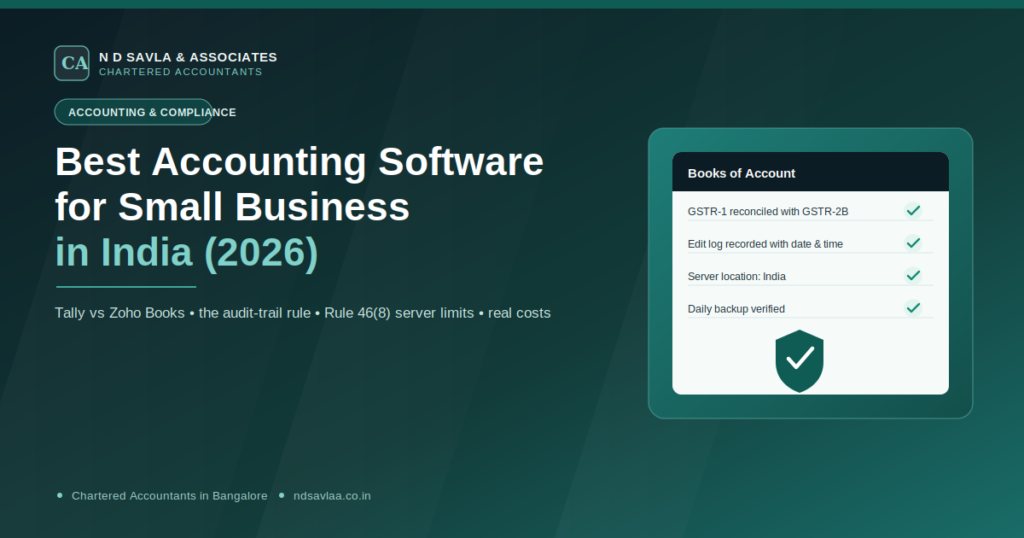
Best Accounting Software for Small Business in India 2026 CA N D SAVLA & ASSOCIATES CHARTERED ACCOUNTANTS For Consultation +91 9743 000 773 Accounting & Compliance Best Accounting Software for Small Businesses in India: Which One Should You Choose? Tally vs Zoho, the audit trail rule, Rule 46(8) server limits and what these packages really cost — measured against Indian law as it stands for 2026-27. By N D Savla & Associates · 27 August 2026 · Chartered Accountants in Bangalore The best accounting software for small business in India is the package that clears three tests at once: it handles GST compliance correctly, it records an audit trail your auditor can rely on, and it keeps your books of account on servers located in India. Feature lists matter far less than those three. For most small businesses the shortlist is short. TallyPrime remains the default where inventory management matters or the accountant already works in Tally. Zoho Books is the strongest cloud accounting software for service-led businesses and startups. Busy and Marg ERP suit trading and distribution, while Vyapar and myBillBook serve micro traders who mainly need billing. Choosing badly is no longer just an inconvenience. From 1 April 2026 the Income-tax Act, 2025 and the Income-tax Rules, 2026 govern your records, and the tax audit report in Form No. 26 now asks your auditor to name the software you use and state where its server sits. Software selection has become a compliance decision. What Makes Accounting Software “Best” for a Small Business in India? The best accounting software for small business in India is defined by regulatory fit, not feature count. Software built for the United Kingdom or the United States can produce perfectly tidy accounts and still fail at the first GST return, because Indian compliance is invoice-level, deadline-driven and audited against the government portal. Three requirements are non-negotiable for GST accounting software used by any Indian business: Correct GST handling: HSN and SAC codes, place-of-supply logic that splits CGST, SGST and IGST correctly, credit and debit notes, and GSTR-1 and GSTR-3B outputs that reconcile with GSTR-2B. A change log: every entry and every subsequent edit recorded with a date, so the books can be reconstructed during an assessment or audit. Indian data residency: your records accessible in India, with the backup held on servers physically located in India. After that, fit to your business decides the rest: inventory management depth if you carry stock, e-invoicing if you are near the turnover threshold, multi-GSTIN support if you operate across states, and payroll if you employ staff. A short conversation with whoever handles your GST registration and return filing will usually narrow the field faster than a fortnight of demos. Which Accounting Software Is Best for Small Businesses in India Right Now? Six options cover almost every requirement when shortlisting the best accounting software for small business in India. The list below reflects the accounting software for MSMEs that businesses and Chartered Accountants actually run in 2026, rather than global rankings that ignore GST. TallyPrime The largest install base of any accounting software in India, and still the default for businesses carrying stock. Strengths are inventory management, speed of data entry, offline working and the fact that nearly every accountant can read a Tally file. It is a desktop product, so remote access needs hosting arranged separately. Zoho Books The strongest cloud accounting software for Indian small businesses, and the most complete GST accounting software of the cloud options, built in India for Indian tax. It files GSTR returns directly, connects to bank feeds, supports e-invoicing, and gives your CA real-time access instead of emailed backup files. A free plan is available for businesses with annual turnover below ₹25 lakh. Busy Accounting Software Built for trade and distribution. Batch tracking, salesman-wise reporting and multi-branch handling are stronger out of the box than in most competitors, which makes it a common TallyPrime alternative for wholesalers. Marg ERP Dominant in pharmaceutical distribution and FMCG retail, where expiry tracking, scheme management and barcode workflows matter more than general accounting depth. Vyapar and myBillBook Mobile-first billing tools rather than full accounting systems. Both suit kirana stores, small traders and service providers who need GST invoices, basic stock and receivables tracking without an accountant on staff. ERPNext Open-source, GST-ready and free of per-user licence fees, which appeals to businesses that want to self-host in India. It needs implementation help, so budget for a partner rather than treating it as a free option. 📋 Note Ask any vendor two questions in writing before you pay: can the audit trail be disabled by any user, and in which country do the live server and the daily backup physically sit? Keep the reply on email. If a compliance question arises three years from now, that email is evidence, and a sales call is not. Does Your Accounting Software Legally Need an Audit Trail? Yes, if your business is a company. Under the proviso to Rule 3(1) of the Companies (Accounts) Rules, 2014, for financial years commencing on or after 1 April 2023, every company that uses accounting software to maintain its books of account must use software that records an audit trail of each and every transaction, creates an edit log of every change along with the date it was made, and ensures the audit trail cannot be disabled. The Rules are notified by the Ministry of Corporate Affairs and available on the MCA portal. The obligation does not stop with management. Under Rule 11(g) of the Companies (Audit and Auditors) Rules, 2014, your statutory auditor must separately verify and report on whether the audit trail feature was used and operated throughout the year. That creates a maker-checker structure: you implement it, and your auditor tests it and says so in the audit report. Two practical points follow. First, the requirement applies to companies only, so a proprietorship, a partnership firm or an LLP is not covered by Rule 3(1). Second, contravention of the books
Hello world!
Welcome to WordPress. This is your first post. Edit or delete it, then start writing!



